
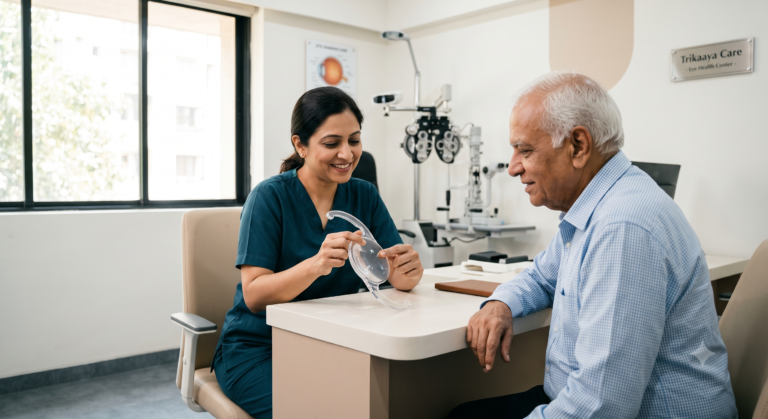
If you or a loved one has been diagnosed with cataracts, you probably noticed that the world is starting to look like you are peering through a foggy, unwashed window.
When patients visit our Ophthalmology department at Trikaaya Care in Kandivali West, Mumbai, their first priority is getting their clear vision back. But right after that comes the biggest question: “Doctor, how much is this actually going to cost?”
If you have started researching online or asking friends, you have likely heard wildly different numbers. One neighbor might have paid ₹30,000, while another paid over ₹1,00,000 per eye. Why is there such a massive gap?
The truth is, the hidden costs of cataract surgery usually have very little to do with the actual surgical procedure itself. The final bill is almost entirely determined by the tiny, artificial piece of plastic you choose to put inside your eye: the Intraocular Lens (IOL). Here is exactly how to navigate your options without overspending.
The Surgery is Standard; The Lens is Not
To understand the cost, you need a quick layman’s breakdown of the surgery. Cataract surgery is essentially a swap. The surgeon removes your eye’s natural, cloudy lens and replaces it with a brand-new, clear artificial lens.
The advanced micro-surgery used to remove the cloudy lens (called Phacoemulsification) is a standard medical procedure. The cost for the surgeon’s time, the operation theater, and the equipment remains fairly consistent. The massive price jump happens when you sit down to select your new lens.
Think of it like buying a car. The base model will get you from point A to point B perfectly well. But if you want a sunroof, leather seats, and self-driving features, you are going to pay a premium. Lenses work exactly the same way.
Option 1: Standard Monofocal Lenses (The Budget-Friendly Choice)
A monofocal lens has one single point of focus. In most cases, the surgeon sets this lens for long-distance vision.
- The Result: You will be able to drive, watch TV, and recognize faces across the street with perfect clarity.
- The Catch: Because the lens cannot adjust its focus, you will absolutely need to wear reading glasses for up-close tasks like looking at your phone, reading the newspaper, or chopping vegetables.
- The Cost: This is the most affordable option and is widely covered by standard health insurance policies.
Option 2: Premium Multifocal Lenses (The Lifestyle Upgrade)
If you have spent your whole life wearing glasses and want to use this surgery as an opportunity to finally get rid of them, a premium multifocal lens is the answer.
- The Result: These highly advanced lenses have different circular zones built directly into them. They allow your brain to seamlessly focus on things far away, at arm’s length (like a computer screen), and up close.
- The Catch: They are significantly more expensive. Furthermore, they are not always a perfect fit for everyone; some patients experience mild glare or halos around streetlights when driving at night.
- The Cost: Because this is considered a “lifestyle upgrade” rather than a medical necessity, the extra cost for a multifocal lens is usually paid out-of-pocket, even if you have insurance.
Option 3: Toric Lenses (For Astigmatism)
Astigmatism means your eye is shaped slightly more like an egg than a perfectly round football, which distorts your vision. If you have astigmatism, a standard monofocal lens will not fix it. You will still need prescription glasses for both distance and reading after the surgery.
Toric lenses are premium lenses custom-built to correct astigmatism at the exact same time your cataract is removed. They are more expensive than standard lenses, but they are incredibly effective for patients with irregular eye shapes.
How to Make the Right Choice
Do not let the fear of high costs push you into making a quick decision. The lens you choose will be in your eye for the rest of your life, so it needs to match your daily routine.
If you are an avid reader, work on a computer all day, and hate wearing glasses, investing in a premium multifocal lens might be the best money you ever spend. If you are perfectly comfortable wearing reading glasses around the house, a standard monofocal lens will provide brilliant, clear vision at a fraction of the cost.
Before you make a decision, schedule an eye evaluation with our specialists to discuss [Cataract Surgery]. We will map the exact shape of your eye, review your lifestyle, and help you choose the perfect lens for your budget—with zero hidden surprises.

![We asked our doctors one simple question… and clearly, there’s a lot we’ve been ignoring. 👀
Here’s what they had to say.
#doctorqna #healthawareness #doctoradvice #trikaayacare #clinicinkandivali
[ doctor Q&A, health awareness, common health concerns, health tips, preventive healthcare, dental health, skin health, eye health, orthopaedic health, wellness, Trikaaya Care, Kandivali West, Multispeciality clinic in Mumbai ]](https://trikaayacare.com/wp-content/plugins/instagram-feed/img/placeholder.png)